
The Enneagram
"The most dangerous form of blindness is believing that one's own perspective is the only reality." – Friedrich Nietzsche
Nine Ways to See the World and Yourself
We all have a very specific way of looking at the world and ourselves. Thanks to modern insights in neurobiology and psychology, we know this is not a purely cognitive process. Instead, it involves a complex interplay between our nervous system, our emotional tendencies, and the mental interpretation of this information.
The Enneagram reveals that there are nine fundamentally different perspectives on the world. Nine different value systems, assumptions, focal points, and reactions to what we perceive. Nine filters through which we interpret reality.
The Enneagram Symbol and its Architecture
The geometric structure as the key to understanding the Enneagram
The Enneagram symbol is not just a diagram. The architecture of the Enneagram encodes the dynamics of human consciousness: how attention moves, how it contracts and expands, and how patterns emerge, differentiate, and develop.
It allows the Enneagram to function as a tool for orientation, insight, and transformation, rather than just a static table or checklist. At its core, the Enneagram is a fusion of three geometric elements: a circle, a triangle, and a hexagram (a six-pointed figure). Each element conveys its own principle.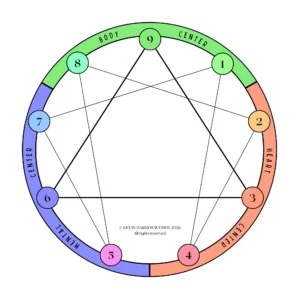
The Circle
The circle expresses wholeness and integration. The Enneagram is consciously not a table that puts people into boxes, but a self-contained system. The circle symbolizes the holistic nature of the human psyche and that every personality pattern stands in relation to the others.
The Triangle
The triangle represents emergence, differentiation, and dynamic tension. Our mind interprets the world and ourselves primarily through opposites. Heat only makes sense because we also experience cold, darkness can only exist where light is absent, etc. The triangle reminds us that there are aspects within ourselves that we have repressed or suppressed. The art lies in allowing these inner contradictions and accepting all sides of ourselves.
The Hexagram
The hexagram encodes rhythm, timing, and the non-linear flow of developmental processes. Our personal transformation is not a straight path, either. We experience pauses, interruptions, and sometimes even temporary regression. The hexagram normalizes these experiences.
Triads. The Patterns of Our Perception
The recurring threefold structures that shape identity and perception
The Enneagram structures human experience not randomly, but in recurring patterns of three by three. Three central patterns and three differentiated expressions within each group. This arrangement of threefold divisions is called Triads in the context of the Enneagram. The Triads help us recognize where we locate our identity, which area of our experience we prefer, and which dimensions we tend to lose sight of. They shift the focus away from behavior and toward perception, orientation, and inner emphasis.
The Centers of Intelligence form the most fundamental of these Triads. However, there are many other such groupings of three within the Enneagram, which illuminate different aspects of being human as well as our patterns and strategies. The various Triads are therefore not just supplementary information to the Enneagram, but an integral part of it. Like a kaleidoscope, what we see changes fundamentally when we turn it just a little.
The Three Centers of Intelligence
How Body, Heart, and Mind Structure Our Perception and Personality
The Enneagram points out that human experience is organized through three fundamental areas: instinctual sensation, emotional resonance, and cognitive processing. These areas are different modes of perception and contact through which we experience ourselves, others, and the world. In the Enneagram, they are referred to as Centers of Intelligence. They are the foundation of the Enneagram and the nine types.
Each center has its own form of intelligence, sensitivity, and orientation. And each center is susceptible to specific compensation when we lose direct contact. Personality is strongest where consciousness organizes and narrows itself around this loss of contact. Our Enneagram type therefore does not describe who we are, but rather how our attention preferentially aligns itself and where it habitually gets stuck.
If a center is overemphasized, suppressed, or disconnected, characteristic patterns and reactive strategies emerge. All humans seek autonomy and support, relationship and appreciation, orientation and security. Likewise, we all experience anger, shame, and fear. But which of these emotions primarily accompany us, which needs we prioritize, and through which center we try to fulfill them, differs fundamentally. This is exactly where the Centers of Intelligence come in.
Together, the centers describe how human experience is structured and becomes understandable. They help us distinguish sensation from feeling and feeling from thinking. Many inner conflicts arise exactly where these areas are mixed up: when bodily needs are “thought away,” emotional longings are replaced by control, or existential uncertainties are to be answered purely mentally.
Working with the centers is a return to forms of intelligence that are often overlooked or devalued in our society today. It is important to emphasize: We always experience the world through all three centers. We are not thirds of a human being. The decisive difference lies in the order and weighting with which our psyche uses them to organize experience. Only when body, heart, and mind are consciously integrated does a person unfold their full potential.
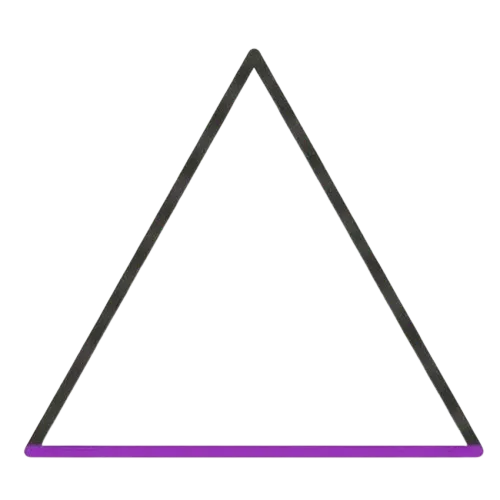
The Body Center
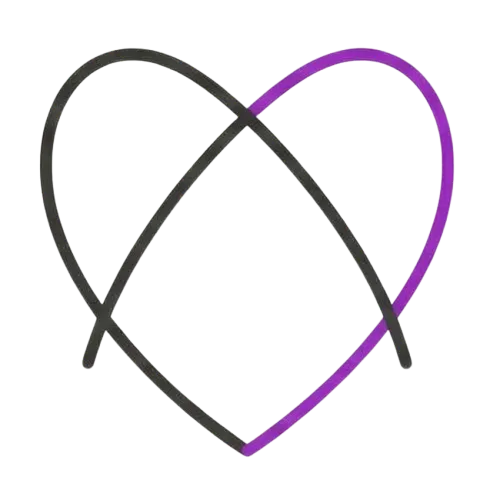
The Heart Center

The Mental Center
Lines. The developmental dynamics of your type
How the connecting lines make stress and resources visible
The only constant in this universe is change. Our life situation, our environment, our emotional and mental well-being, and the issues that currently occupy us are constantly shifting. All of this influences how we behave and thus how we express our type. This is where the Enneagram symbol comes into play. The lines that connect the types are of special importance. They give the symbol its concrete dynamic, which makes the Enneagram unique and beautifully complex. The lines describe the psychodynamics of the types.
Depending on context, our psyche draws resources from the types at either end of the lines leading away from it. Sometimes, we take on the shadow aspects of these points. Sometimes we utilize the positive aspects of these points. But often, we tend to use them for further avoidance rather than conscious growth. However, these lines can also reveal the strengths we can develop through conscious self-reflection.
Understanding and using the Enneagram
Why it is so important to find your correct Enneagram type
The value of the Enneagram does not lie in explaining to us who we are, but in showing us where and how we limit ourselves. Each type describes a specific way of dealing with the fundamental tensions of being human: with fear, shame, or anger, with the need for security, value, or autonomy.
Our Enneagram type describes a dominant fixation, a preferred starting point from which we interpret ourselves and the world. All nine patterns exist in every person. However, they are not equally weighted; one pattern stands in the foreground. Exactly there lie our most stubborn habits, our most familiar inner loops – and paradoxically, our greatest untapped potential.
The Enneagram is a map of the human psyche. And as with any map, a simple but crucial question arises first: Where am I right now? Without this orientation, the map remains abstract. One can feel drawn to paths, recognize landscapes, or try out different routes – and still move in circles.
Translated to inner work, this means: As long as we do not begin from our actual starting point, development remains diffuse. Insights remain interesting, but without consequence. Change becomes arduous or fails to happen altogether. Determining one’s own dominant type is precisely this act of orientation.
It shows from which inner place we typically think, feel, and act. When we start at the right point, attention gathers. The work becomes more concrete, and change begins to gain depth. Therefore, I approach the nine types not primarily as personality profiles, but as expressions of deeper inner structures. A correct identification of your dominant type is therefore not a cosmetic process, but of fundamental importance.
Curious to find your dominant type?
Let’s find out where you stand on this map. In an individual typing session, I will help you accurately identify your dominant Enneagram type and understand the unconscious patterns behind it. And how you can leverage that information for your personal growth.
The 9 Patterns of Human Experience
Each type reflects a natural way of perceiving, emoting, and acting in life. Explore the one that resonates most with you.
Alignment and Integrity
Type One represents the part of us that strives for alignment, integrity, and consistency. It is the aspect of the human psyche that senses that life follows an innate order, and that it is our task to orient ourselves toward it. Through One, we experience an intuition for how things could be: clearer, more truthful, more coherent. In its healthy form, this energy brings forth conscientiousness, maturity, self-discipline, and a deep devotion to goodness.
Ones perceive the world with a keen sensitivity to deviations. They immediately notice what is off, what could be improved, or what is out of balance. This is not experienced as a deliberate search for flaws, but as a natural orientation of attention – a built-in radar for inconsistency and error. What often remains outside of awareness, however, is what is already sufficient, already working, already good enough. Attention is drawn to what needs correction far more readily than to what can simply be appreciated.
Ones tend to experience their perception not as a personal preference, but as something inherently true. What they see as “misaligned” does not feel subjective, it feels objectively in need of correction. From this arises a strong sense of responsibility. They act reliably and with commitment, often with a sincere desire to contribute to a better, more coherent world. Within them lives a serious impulse to improve, rooted in an inner need for sincerity and truth.
To maintain this sense of correctness, Ones develop a life strategy centered around self-regulation and improvement. They monitor themselves carefully, restrain impulses that might lead them astray, and continuously refine their behavior and environment. The underlying logic is simple and powerful: if I stay in control and correct what is wrong, I can prevent error, failure, and moral compromise.
At its core, the drive for integrity arises as a response to a deeper fear: the fear of being flawed, corrupted, or morally wrong. The striving toward goodness is not arbitrary: it is an attempt to ensure that nothing falls out of alignment. Beneath the surface lives a quiet but powerful conviction: I must be good, I must be correct, in order to be worthy.
Over time, this strategy can harden into an internalized system of control. Many Ones carry within them a strong inner voice that constantly evaluates thoughts, feelings, and actions. This inner commentary does not merely guide, it judges. Mistakes are not experienced as part of being human, but as personal shortcomings that must be corrected. What began as a sincere orientation toward goodness can become a permanent internal mode of correction.
In order to maintain their sense of integrity, Ones often push certain impulses out of awareness, especially those that feel messy, excessive, or morally questionable. Anger, in particular, is tightly regulated or suppressed. Yet this energy does not disappear. It accumulates beneath the surface and condenses into a quiet but persistent tension, often experienced as simmering resentment. Outwardly, Ones may appear composed, rational, and self-controlled; inwardly, they may feel pressured, irritated, or burdened by a constant sense that something is not yet right.
Subjectively, many Ones experience themselves as tense, contained, and under subtle but chronic pressure. Their bodies often carry a sense of tightness, as if something must continually be held in place. This can manifest as strictness, inflexibility, or inner hardness, but also as moral superiority or quiet irritability. Beneath all of this often lies a more vulnerable experience: a quiet sorrow that goodness, as they imagine it, never seems fully attainable.
Herein lies a central paradox of the One. They possess a deep and genuine sense for truth, goodness, and integrity – yet lose contact with these very qualities when they become fused with their internal standards. Judgment turns into condemnation. Devotion becomes self-imposed constraint. The desire to do what is right gradually separates them from compassion. First toward themselves, and eventually toward others. Life begins to be filtered through a subtle lens: it could be good, if only… and in this movement, the goodness that is already present is easily overlooked.
On a deeper level, Ones carry an essential truth about life: that integrity matters, that awareness brings responsibility, and that alignment has value. Their deepest quality is a quiet wisdom, a sensitivity for what is essential and meaningful. Their developmental task is not to abandon their principles, but to loosen their rigid identification with them. Growth begins when they no longer confuse perfection with virtue. As Ones begin to trust that they do not have to be perfect in order to be good, that worth is not dependent on flawlessness, their inner climate changes.
In more integrated expressions, Ones embody a calm, grounded authority. They can see what could be improved without needing to fight against what is. Their actions no longer arise from internal pressure, but from a deeper alignment with life as it is. Self-control transforms into self-leadership. Resentment becomes a constructive force for meaningful change. And their original gift – the capacity to sense truth and act with integrity – can finally express itself with warmth, humanity, and quiet joy.
A helpful reorientation for Type Ones is: I can be imperfect and still be good. Virtue does not arise from coercion, but from presence. Life does not need to be forced into alignment, I can allow it to unfold naturally.
Attunement and Emotional Resonance
Type Two represents the part of us that connects with the world through outgoing affection, relationships, and emotional resonance. It is the aspect of the human psyche that senses that life happens in togetherness and that love, care, and connection are fundamental. Through Type Two, we experience our ability to connect with others, perceive their needs, and create intimacy. In its healthy form, this energy brings warmth, compassion, generosity, and a natural intelligence of the heart that nourishes and enlivens relationships.
Twos often appear open, friendly, and approachable. They have a keen sense of what others might need, even before it is explicitly stated. Their attention is relationally focused: they listen between the lines, read moods, and respond intuitively to emotional signals. Many Twos effortlessly create a sense of “I am seen.” They offer support, encouragement, and practical help, and experience meaning and vitality especially where they are needed and can make a positive difference in the lives of others.
At the same time, this strong relational focus comes with a characteristic blind spot. While Twos are highly attuned to the needs and emotional states of others, they do not automatically register their own needs, limits, or signs of inner depletion with the same clarity. Attention flows outward with ease, while inward signals are often downplayed, reinterpreted, or overlooked altogether. What others need feels urgent and real, what they themselves need can feel secondary or even unimportant.
Underneath this lies a specific relational strategy: by attuning to others, anticipating their needs, and making themselves indispensable, Twos attempt to secure worth, closeness, and belonging. The underlying logic is rarely experienced as a strategy, however. It feels like a simple truth about life: that love is expressed through care, that relationships are sustained through giving, and that being needed is a natural path to being valued.
The central fear of Twos is being unwanted, unimportant, or unlovable. In order to avoid this pain, they move away from their own neediness and toward the needs of others. Their own desires are put aside, downplayed, or even ignored. They inflate their sense of worth by becoming indispensable. In this way, they secure relationships, but often at the cost of inner exhaustion or quiet disappointment when their devotion is not reciprocated in the hoped-for way.
Subjectively, many Twos feel emotionally present, engaged, and connected, while inwardly harboring a quiet resentment. They know very well what others need, but don’t always feel seen or nurtured themselves. Unspoken needs transform into hidden expectations. If closeness isn’t reciprocated in the desired way, it can lead to hurt feelings, resentment, or a sense of inner emptiness. This pain is rarely named directly but manifests indirectly, for example, through subtle pressure, emotional overemphasis, or the sense that others should respond in kind.
Herein lies a central paradox of the Two. They possess a big heart and a natural capacity for deep empathy. Yet, they lose precisely this connection to themselves when they fail to acknowledge their own neediness. In their attempt to create closeness, they sometimes miss the mark when it comes to genuine intimacy. For true connection arises not only from giving but also from receiving. Many Twos yearn deeply to be loved for who they are, but have learned that it feels safer to be irreplaceable than to be openly in need.
On a deeper level, Twos carry important truths about life: that love connects, that relationships are fertile ground for human growth, and that the heart possesses its own intelligence. At their core, they know that caring is a powerful force and that human closeness has a healing quality. Their gift lies in opening emotional spaces where growth, comfort, and mutual development become possible.
The developmental task for Twos is to no longer exclude their own needs. Growth means treating themselves with the same attention that is naturally given to others. Integrating Twos lean toward self-respect, clarity, and emotional honesty. Not by abandoning compassion, but by allowing it to flow inward as well. When they begin to feel that they don’t have to give to be lovable, their relationship dynamics fundamentally change.
In their mature form, Twos live from inner abundance. Giving then happens freely, not out of fear. Closeness arises without hidden expectations. They can be present with others without losing themselves, and love without neglecting themselves. Their heart remains wide open but is no longer dependent on validation. In this state, their affection becomes a true gift. Warm, welcoming, and nurturing for all who receive it.
A helpful reorientation for Type Two is: My needs are just as important as those of others. I can receive without having to give something first. Only when my glass is full can I truly give to others.
Authenticity and Purpose
Type Three represents the part of us that connects with the world through achievement, effectiveness, and success. It’s the aspect of the human psyche that senses action matters, that goals can be reached, and potential wants to be realized. Through Type Three, we experience our ability to focus, move things forward, and be visibly effective. In its healthy form, this energy produces clarity of purpose, drive, adaptability, and an inspiring presence that motivates and engages others.
Threes often appear confident, competent, and goal-oriented. They understand how to concentrate on what’s essential, set priorities, and achieve results. Their attention is focused on what works, what moves the needle forward, and what promises success. Many Threes have a keen sense of what’s required in a given context and adapt their behavior and presentation accordingly. They can be extremely efficient, charismatic, and high-performing, and experience vitality particularly where progress, recognition, and visible results are generated.
At the center of the Threes perception lies a specific attentional bias and blind spot: their awareness is magnetically drawn toward goals, results, and signals of success, while inner experience – feelings, limits, and authentic desires – tends to fade out of view. What cannot be measured, optimized, or translated into effectiveness often feels irrelevant or even obstructive. This creates a subtle misperception: that inner life is secondary, and that identity is something that is constructed through performance rather than discovered through presence.
At the same time, this very strong focus on success can become twisted in a way that is internally costly. What begins as healthy ambition can subtly become intertwined with one’s self-worth. Many Threes don’t experience value as something inherent within them, but rather as something that must be validated through achievement. This creates an inner conviction: “I am what I achieve. I am valuable when I am successful.” Their attention increasingly focuses on external impact, efficiency, and image, while their connection to their own feelings and inner needs fades into the background.
The core fear of Type Threes is being worthless, insignificant, or unsuccessful. Stagnation feels threatening. The fear of not being seen, not receiving recognition, or being perceived as average strikes at the heart of their inner insecurity. To avoid this feeling, Threes strongly identify with roles, goals, and images of success. They become what works. Feelings that could hinder performance are efficiently pushed aside. This creates an internal mode of functioning that can appear impressive but often comes at the cost of inner emptiness.
Subjectively, many Threes experience themselves as focused, active, and high-achieving, while inwardly they lose touch with their authentic experience. They know exactly what needs to be done, but feel less and less about who they truly are beyond their successes. External recognition becomes their most important resource for maintaining an inner sense of worth. If this recognition is lacking, or if success falters, a deep insecurity or exhaustion can suddenly surface. Behind the glittering surface often lies the question: Who am I, if I’m not achieving anything?
Herein lies the central paradox of the Three. They possess enormous potential to bring things into the world and inspire others. But by identifying with their actions, they lose access to their true being. Closeness is possible as long as they are admired or validated, but feels dangerous as soon as it demands authenticity instead of performance. Many Threes yearn to be truly seen, but have learned that it’s safer to be admired than to be truly recognized.
On a deeper level, Threes carry an essential truth about life: that development is possible, that potential yearns to be realized, and that purposeful action creates impact. At their core, Threes know that commitment and direction move life forward. Their gift lies in focusing energy, generating action and movement, and realizing visions. They remind us that inner impulses are allowed to find outward expression.
The developmental task for Type Three is to no longer tie one’s self-worth to achievement. Growth means pausing and encountering oneself beyond success and image. Integrating Threes lean toward authenticity, presence, and emotional truthfulness. Not by losing drive, but by drawing it from within. When Threes begin to feel that they are valuable even without achievement, their inner motivation fundamentally changes.
In their mature form, Threes act from authenticity rather than performance. Success then becomes an expression of inner direction, not a substitute for a lack of self-worth. Type Threes can be present without being self-aggrandizing, and act effectively without losing themselves in the process. Their actions become more transparent, more human, and more sustainable. In this state, they no longer inspire through perfection, but through their palpable authenticity.
A helpful reorientation for Type Threes is: My worth does not depend on my performance. I am allowed to pause, feel, and simply be. Authenticity is more effective than any image.
Depth and Emotional Truth
Type Four represents the part of us that connects with the world through depth, emotionality, and inner truth. It is the aspect of the human psyche that senses that life needs meaning, that authenticity is more important than conformity, and that what is essential often lies within. Through Type Four, we experience our capacity to feel, to differentiate ourselves from others, and to perceive the subtle nuances of experience. In its healthy form, this energy brings forth sensitivity, creativity, emotional honesty, and a deep connection with one’s own inner experience.
Fours often appear sensitive, reflective, and inwardly rich. They perceive moods, nuances, and emotional atmospheres that easily escape others. Their attention is primarily directed inward: to feelings, longings, inner stirrings, and what is missing or not yet quite right. Experience is intuitively filtered through emotional meaning, and what carries intensity tends to register as significant. What is calm, sufficient, or simply “okay” often fades into the background of awareness, as if it lacks the depth required to feel real. Many Fours possess a natural aesthetic sensitivity and a sense for the unique. They experience vitality where depth, authenticity, and emotional intensity are possible.
At the same time, this strong inward focus can intensify in a way that becomes painful. What begins as healthy self-awareness can become intertwined with one’s identity and self-worth. Many Fours experience their self through feelings of being different or lacking. This creates an inner conviction: “There’s something wrong with me. I’m missing something essential.” Attention increasingly moves toward what is absent, what feels out of reach, or what others seem to possess with ease. Emotional states grow stronger, more vivid, and more defining and so become the measure of identity.
The central fear of Type Four is being insignificant, interchangeable, or inwardly empty. Being like everyone else feels threatening. The idea of not having a unique place in life strikes at the core of their insecurity. To escape this, Fours turn toward their inner world, intensify their emotional experience, and shape their identity around their uniqueness and their depth. Pain is not only felt but often held onto, because it confirms the sense of being real and distinct. An implicit logic emerges: my depth comes from what I feel, and what I feel most strongly is what is missing. If the longing were to disappear, something essential about who I am might be lost as well.
Subjectively, many Fours experience themselves as emotionally aware, reflective, and intense, while inwardly harboring a deep dissatisfaction or longing. They know precisely what they lack but are less aware of what they already possess. Comparisons with others reinforce the feeling of being excluded or disadvantaged. Recognition or closeness can be touching, but often does not last, because what is steady, available, and sufficient is easily overlooked or does not fully register as meaningful. In contrast, what is absent, distant, or idealized draws attention and emotional energy. Behind this emotional depth often lies the quiet question: Why does life seem easier or more complete for others than for me?
Herein lies the central paradox of the Four. They possess an extraordinary capacity for sensitivity, compassion, and inner truth. Yet, by orienting themselves toward what is missing, they lose contact with the richness that is already present. The more they search for what completes them, the more their attention confirms the experience of lack. Closeness is deeply longed for, but can feel fragile as soon as it fails to match an inner ideal of resonance and understanding. Many Fours yearn to be seen as they truly are, but have learned to assume that this kind of recognition will always remain just out of reach.
On a deeper level, Fours carry within them an essential truth about life: that depth matters, that feelings have meaning, and that truth cannot be found on the surface. At their core, Fours know that emotional honesty and inner richness are sources of beauty and connection. Their gift lies in making the unspeakable tangible, opening inner worlds, and allowing others access to their own feelings.
The developmental task for Type Four is to no longer derive their worth from what is missing or different. Growth means learning to recognize and receive what is already here, and to allow sufficiency to be experienced as meaningful. Integrating Fours lean toward groundedness, presence, and inner stability – not by losing depth, but by rooting it in reality. As they begin to notice that contentment, simplicity, and ordinariness also carry value, their emotional life becomes more spacious. The intensity remains available, but it no longer needs to define their identity.
In their mature form, Fours live from inner abundance rather than from longing. Feelings can move freely without needing to be held onto or amplified. Satisfaction and completeness become visible alongside depth. Fours can express their uniqueness without separating themselves from others, and experience closeness without constant comparison with internal ideals. Their presence becomes quieter, clearer, and at the same time profoundly touching. In this state, they offer the world emotional authenticity that is grounded in a deep and steady sense of being.
A helpful reorientation for Type Four is: I lack nothing essential. I am complete just as I am now. My depth arises from being present in the moment.
Clarity and Insight
Type Five represents the part of us that connects with the world through observation, understanding, and mental clarity. It is the aspect of the human psyche that senses that orientation arises from insight, that distance creates perspective, and that knowledge can provide a sense of security. Through Five, we experience our ability to grasp complex relationships, remain internally autonomous, and to penetrate reality before acting. In its healthy form, this energy brings about objectivity, independence, and a clear, precise perception.
Fives often appear calm, reserved, and mentally present. They observe more than they participate, listen attentively, and think things through thoroughly before speaking. Their attention is focused on structures, principles, and internal logic. Many Fives have a strong need for privacy and self-determination. They experience vitality where they can understand and penetrate things and recognize connections without feeling pressured or overwhelmed by others.
At the same time, their attention has a specific bias: it is finely tuned to detect complexity, intrusion, and demand, while their own energetic state is not always registered in a direct, embodied way. Instead of feeling their limits in real time, they often infer them mentally and err on the side of conservation. In a similar way, relational approaches from others are not always experienced as invitations for connection, but are more readily interpreted as potential expectations or demands on their time, energy, or autonomy. This perceptual filter quietly shapes how they orient toward the world.
The very orientation toward understanding from a distance can narrow further. What begins as a healthy desire for independence can transform into a premature withdrawal. Many Fives experience the world as demanding, overstimulating, or energy-draining. This leads to an inner conviction: “I don’t have enough resources to cope with the world.” To protect themselves, they withdraw. They reduce their needs, minimize contact, and accumulate knowledge as a form of inner security. The mind becomes a safe haven, while life is increasingly viewed from the outside.
The central fear of Type Five is being overwhelmed, exhausted, or dependent. Dependence feels dangerous because it is experienced as a loss of autonomy and energy. To avoid this fear, Fives strongly identify with the observer role. They want to be prepared before they act, competent before they reveal themselves, and knowledgeable before they engage. Feelings, needs, and physical impulses are often suppressed or analyzed instead of being experienced directly.
Over time, a subtle inner dynamic can take shape: the more they withdraw in order to conserve energy, the less direct experience they gather. The less experience they have, the more they feel they still need to understand before engaging. And the more they feel unprepared, the more natural it becomes to remain at a distance. In this way, withdrawal and the search for clarity can begin to reinforce one another.
Subjectively, many Fives experience themselves as alert, clear-headed, and intellectually independent, while inwardly they feel a subtle isolation. They are knowledgeable but sometimes feel cut off from life itself. Closeness can be interesting but also exhausting. Demands are quickly perceived as intrusions. Energy is carefully conserved, as if it were limited. Behind the apparent independence often lurks the quiet question: What if I don’t have (or know) enough to participate?
Herein lies the central paradox of the Five. They possess an extraordinary capacity for insight, mental clarity and objectivity. Yet, by withdrawing from life, they lose touch with the source of vibrant experience. Knowledge replaces participation. Understanding replaces connection. Many Fives yearn for inner freedom and sovereignty, but precisely through their withdrawal, they experience a growing distance from life.
On a deeper level, Fives carry within them an essential truth about life: that consciousness needs space. That clarity arises when we don’t react immediately. That silence enables insight. At their core, Fives know that true understanding is not superficial, but requires time, contemplation and engagement. Their gift lies in understanding something so thoroughly that they are able to make new perspectives accessible.
The developmental task for Type Five is to re-engage with life. Growth doesn’t mean thinking less, but rather connecting thought with experience, and thus transforming knowledge into wisdom. Integrating Fives lean toward a greater sense of aliveness, embodiment, and trust in one’s own ability to stay connected to life – not by relinquishing autonomy, but by embodying it. When they begin to feel that participation can release energy instead of consuming it, their inner relationship to the world fundamentally shifts.
In their mature form, the Five lives from inner abundance rather than from a feeling of not having enough. Knowledge is shared without feeling deprived. Closeness becomes possible without fear of being overwhelmed. Fives can be present and engage without abandoning their boundaries. Their minds remain clear, but they are no longer separate from life. In this state, they offer the world insight, clarity, and orientation nourished by direct experience.
A helpful reorientation for Type Five is: I have enough. I am allowed to participate. Life nourishes me when I allow myself to engage with it.
Loyalty and Courage
Type Six represents the part of us that connects with the world through certainty, loyalty, and courage. It is the aspect of the human psyche that senses life requires reliability, that dangers must be anticipated, and relationships must be secured. Through Six, we experience our ability to recognize risks, take responsibility, and align ourselves with something larger that provides us with support and direction. In its healthy form, this energy brings forth vigilance, commitment, courage, and a deep willingness to stand up for people, values, and community.
Sixes often appear attentive, engaged, and outwardly alert. They scan their surroundings, ask questions, examine assumptions, and pay attention to what could go wrong. Their attention is focused less on the ideal and more on what is possible. What did we miss? What is uncertain? What can be relied upon? Many Sixes possess a keen sense of moods, power dynamics, and unspoken risks. They experience vitality where clarity is established, where agreements are kept, and where trust proves resilient.
At the same time, their perception is drawn much more strongly to what could become dangerous than to what is already safe. Potential threats are registered quickly and vividly, while existing stability or support is more easily taken for granted or quietly fades into the background. This very focus on certainty can narrow in a way that becomes internally upsetting. What begins as healthy vigilance can transform into mistrust. Many Sixes experience the world as potentially dangerous or unpredictable.
Uncertainty itself is felt as a form of instability that needs to be resolved. This creates a fundamental inner assumption: “I am not safe on my own. I need something outside of myself that I can trust.” This something can be an authority, a relationship, a system, a conviction, or even their own doubt. The mind remains in motion, constantly searching for certainty, which is never fully attained. Authority and guidance can therefore feel both reassuring and suspect at the same time: longed for as a source of safety, yet simultaneously questioned and tested for reliability.
The central fear of the Six is being left without support or stability. Being abandoned, making a mistake, or acting incorrectly in a dangerous situation feels existentially threatening. To avoid this fear, Sixes develop a complex internal security management system. They mentally rehearse scenarios, ask questions, seek reassurance, or test loyalty. Doubt becomes a constant companion. It’s an attempt to create a sense of security through reason. Mentally, Sixes remain active, vigilant, and on edge. In this way, fear and courage often coexist: the same inner alertness that generates anxiety also mobilizes the energy to prepare, to question, and to stand firm when it truly matters.
Subjectively, many Sixes perceive themselves as responsible, attentive, and committed, while inwardly they feel a constant sense of uncertainty. Trust feels fragile. Even clear decisions can be questioned immediately after. Authority is both sought and doubted. Closeness is important, but it can also trigger anxiety because it makes one vulnerable. Behind this constant inner alertness often lies the question: Whom or what can I truly trust?
Herein lies the central paradox of the Six. They possess an enormous capacity for loyalty, courage, and reliability. Yet, by seeking security externally, they lose touch with their own inner authority. Doubt is meant to protect them, but it undermines precisely the trust they crave. Many Sixes yearn for stability, but their constant questioning creates the very uncertainty they seek to protect themselves from.
On a deeper level, Sixes carry within them an essential truth about life: that trust is not blind, but can certainly be tested. That courage is not the absence of fear, but the ability to act despite fear. At their core, Sixes know that community, loyalty, and mutual support are sustaining forces. Their gift lies in recognizing risks, taking responsibility, and standing up for what is important to them, even when things become uncertain.
The developmental task for Type Six is to shift trust inward. Growth doesn’t mean no longer being afraid, but rather taking one’s own inner compass seriously. Integrating Sixes lean toward self-confidence, determination, and courage lived out. Not by suppressing doubt, but by relinquishing its final say. When they begin to feel they can trust themselves, their relationship to authority, others, and life fundamentally changes.
In its mature form, the Six thrives on inner stability. Doubt transforms into clear thinking, fear into vigilance, and the search for external guidance into conscious choice. Sixes can commit without losing themselves and question without destabilizing everything. They act courageously, not because they are absolutely certain, but because they trust themselves. In this state, they become pillars of support for others – people you can rely on, especially when things get tough.
A helpful reorientation for Type Six is: I can trust myself. Courage arises when I act despite uncertainty. Confidence grows from within.
Freedom and Joy
Type Seven represents the part of us that connects with the world through possibilities, enthusiasm, and mental flexibility. It is the aspect of the human psyche that senses life needs expansiveness, that experiences must be savored, and dreams want to be realized. Through Seven, we experience our ability to see options, open up new perspectives, and perceive life as rich, interesting, and full of opportunities. In its healthy form, this energy brings forth joy, optimism, creativity, and an infectious openness that generates inspiration and a thirst for adventure.
Sevens often appear vibrant, imaginative, and future-oriented. Their minds are quick, connecting, and associative. They think in terms of possibilities rather than limitations. Their attention is focused on what might come next, what is enjoyable, and what promises joy. Many Sevens have a talent for lightening the mood, seeing new paths, and guiding others out of inner turmoil. They experience vitality where freedom, variety, and positive anticipation are palpable, and where life feels open and unrestricted.
At the same time, this very focus on positive possibilities can narrow in a way that becomes constricting. What begins as healthy openness can solidify into avoidance. Many Sevens experience restriction, pain, or difficult emotions as threatening states that must be escaped or reframed. This creates a fundamental inner assumption: “If I commit myself or stay still, I lose my vitality.” The mind begins to reinterpret, relativize, or bypass unpleasant experiences before they are fully felt. Planning, fantasizing, and generating new options become the go to strategies to move away from discomfort. Life remains in motion, but often only on the surface.
The central fear of the Seven is being trapped: in pain, in lack, in inner emptiness, or in a life without options. Limitation is experienced not only as something to avoid, but as an existential threat that signals loss of freedom and aliveness. To escape this fear, Sevens keep their mind in a constant state of expansion. New possibilities, new visions, new experiences are meant to ensure that there is always a way out. The mind remains alert, proactive, and oriented toward the positive, often amplifying what could be enjoyable while underrecognizing what is already sufficient or enjoyable in the present.
Subjectively, many Sevens experience themselves as optimistic, vibrant, and independent, while inwardly they feel a subtle restlessness and pressure to keep moving. Stillness can quickly feel empty, limiting, or unsafe. Deep emotional processes are intellectualized, reframed, or uplifted before they are truly integrated. Joy is genuine, but often fleeting, because it is tied to anticipation rather than presence. Behind the enthusiasm often lurks the question: What happens when I truly stop and have nothing left to look forward to?
Herein lies the central paradox of the Seven. They possess an extraordinary ability to see freedom, hope, and possibility. Yet, by avoiding pain, they also avoid depth. They seek external freedom but shy away from their inner landscape. Many Sevens yearn for fulfillment but lose it by constantly chasing the next experience. What truly nourishes them often lies not ahead, but in the willingness to remain where they are.
On a deeper level, Sevens carry within them an essential truth about life: that life is rich, that joy is important, and that our time here as human beings can and should be enjoyed. At their core, Sevens know that hope is a driving force and that the mind can create potential. Their gift lies in making possibilities visible, opening up perspectives, and reminding others of life’s joy and potential, even in difficult moments.
The developmental task for Type Seven is to not confuse depth with a loss of freedom. Growth means not just experiencing things, but embodying what is experienced. Integrating Sevens lean toward presence, grounding, and inner contentment. Not by abandoning joy, but by experiencing it more fully, quietly, and sustainably. When Sevens begin to stay instead of moving on, their experience of aliveness fundamentally changes.
In its mature form, the Seven lives from inner abundance. Opportunities no longer need to be chased because the experience is complete in the present moment. Joy arises from depth, not from distraction. Sevens can enjoy without escaping, and be open to new things without becoming scattered. Their minds remain alert and creative, but are no longer driven by the fear of being trapped. In this state, their enthusiasm becomes deeply nourishing, because they embrace life in its entirety. Pleasure, pain, and everything in between.
A helpful reorientation for Type Seven is: I don’t have to escape pain to be free. Depth doesn’t limit me. True fulfillment arises when I stay, feel, and fully experience what is here.
Strength and Protection
Type Eight represents the part of us that connects with the world through strength, assertiveness, and leadership. It is the aspect of the human psyche that understands that life requires action, that boundaries must be set, decisions made, and responsibilities assumed. Through Eight, we experience our ability to take up space, exert influence, and stand up for what is important to us. In its healthy form, this energy fosters self-confidence, determination, generosity, and a natural authority that empowers others.
Eights have direct access to instinctual energy and often appear powerful, present, and action-oriented. Their energy moves outward quickly and decisively. They seem to know what to do, take responsibility when others hesitate, and have little fear of confronting resistance. They possess a natural leadership energy and the ability to stabilize difficult situations. Eights react instinctively, especially where injustice, weakness, or abuse of power is experienced. They have a strong sense of fairness and frequently stand up for those who cannot protect themselves. This protective function is among their deepest qualities, and it often expresses itself as a willingness to take on intensity so others do not have to.
At the same time, this very strength can harden in a costly way. What begins as healthy self-assertion can develop into a permanent combative stance. Many Eights maintain their sense of autonomy and power not through trust, but through control and preemptive force. Instead of allowing themselves to be impacted, they move first. Instead of receiving, they dominate the field. They build an inner fortress and reinforce it through intensity, decisiveness, and an unwillingness to show weakness. They accumulate power, influence, and assertiveness to protect themselves from vulnerability. But the stronger this armor becomes, the more threatening the world appears. Paradoxically, the strategy of making oneself invincible reinforces the feeling of constantly having to defend oneself.
The central fear of Type Eight is being weak and vulnerable, of being controlled, violated, or manipulated. Vulnerability is not experienced as a natural human state, but as exposure that can be used against them. Dependence feels dangerous because it implies loss of control. This gives rise to an unconscious fundamental assumption: Only those who are strong survive. Only those who assert themselves are respected. Only those who control remain safe. In this inner climate, anger becomes the dominant affective energy. It arises quickly, moves through the body with force, and functions as a protective shield that keeps more tender feelings out of awareness.
Subjectively, many Eights experience themselves as vital, intense, and decisive. Their inner experience is one of immediacy and high energy. This intensity can feel vibrant and powerful, but in the long run it can also be exhausting for both themselves and their environment. Outwardly, they often appear unshaken and invulnerable, while inwardly they possess a deep sensitivity that they rarely allow to be seen. They perceive betrayal, injustice, or disloyalty with great acuity. But instead of acknowledging the pain of these experiences, they respond with confrontation, hardness, or withdrawal of trust.
A central paradox of the Eight lies precisely here: They possess a big heart, a deep loyalty, and a profound sense of justice. Yet their way of protecting themselves can cut them off from this very warmth. The saying “hard shell, soft core” captures this dynamic well. They long for honesty, depth, and genuine connection, but have learned that closeness invites risk. They want to be respected, but equate respect with strength and self-sufficiency. This creates an inner tension between the desire for connection and the instinct to remain untouchable and in control.
On a deeper level, Type Eight embodies an essential truth about life: that strength, when used consciously, is a life-giving and protective force; that influence carries responsibility; that life asks to be actively shaped and protected. It reminds us that boundaries are necessary and that protection can be an expression of love. At their core, Eights understand that strength exists to serve life, not to dominate it.
The developmental task for Type Eight is to stop opposing strength and vulnerability. Growth does not mean becoming less powerful, but becoming permeable again. Allowing themselves to be touched, affected, and supported. Integrating Eights lean toward generosity, compassion, and emotional openness without losing their vitality and strength. When they begin to sense that they do not constantly have to fight to be safe, their presence softens without losing its grounded power. Their strength is then used less for defense and more for protection, empowerment, and stewardship.
In its mature form, the Eight uses its energy to open spaces rather than control them. Leadership becomes grounded, protective, and life-serving without becoming dominating. Strength remains, but it is no longer armored. In this state, the Eight can stand firmly and allow closeness at the same time. Autonomy and connection are no longer opposites. The world is no longer perceived primarily as a threat, but as something that can be shaped, protected, and supported with conscious strength.
A helpful reorientation for Type Eight is: I don’t need to harden myself to be safe. True strength includes vulnerability. My strength is here to serve and protect life.
Harmony and Integration
Type Nine represents the part of us that strives for harmony, connection, and inner peace. It is the aspect of the human psyche that bestows tranquility and acceptance, softening the rough edges of human life. Through Nine, we experience our belonging to life as a whole. Ideally, this energy brings profound serenity, patience, and the ability to embrace complexity without fragmentation.
Nines often radiate a calming presence. They can listen without having a specific agenda, mediate between opposing viewpoints, and create spaces where others feel accepted and comfortable. Herein lies a quiet strength rooted in perseverance and an intuitive, bodily sense of how things are interconnected. They do not only understand connection conceptually, they feel themselves as part of a larger field of relationship.
At the same time, this yearning for harmony can narrow in subtle but costly ways. Many Nines maintain their peace not through active engagement, but through a gradual disengagement from their own inner impulses. Instead of standing up for their own priorities, they conform. Instead of addressing tensions and problems, they downplay them. Over time, they do not only suppress their needs, they begin to lose contact with them. Attention drifts outward toward what is expected, comfortable, or already in motion, while their own impulses become quieter, less distinct, and harder to access in real time. What begins as openness can turn into self-forgetfulness.
A central fear of the Nine is the fear of conflict or separation. Conflict is not merely disagreement, but is experienced as a disturbance in the field of connection they rely on for orientation and belonging. They feel that asserting their own perspective could jeopardize their relationships with others or their sense of being included. Therefore, Nines often adapt their actions, opinions, and even their self-image to their surroundings. In this quiet pursuit of harmony, they often replace a sense of personal importance with comfort and belonging, only noticing the consequences when something fundamental has gone missing.
This gives rise to a characteristic inner pattern. The less Nines register their own priorities and impulses, the more they orient themselves through what is already present around them. The more they merge with their environment, the less distinct their own inner direction becomes. This can lead to a gentle but persistent inertia: decisions are postponed, actions delayed, and inner signals muted. Over time, this reinforces the original disconnection, as the absence of movement further dulls the sense of what truly matters to them.
This can lead to a peculiar inner experience: They feel deeply connected to others while simultaneously losing touch with themselves. Nines often know what is good for others before they know what they themselves want. They may feel vaguely dissatisfied or restless without being able to pinpoint the reason. Paradoxically, many Nines appear grounded and present on the outside, while feeling inwardly absent. They may seem uncomplicated, easygoing, and stable, but struggle with inertia, indecisiveness, or a quiet resistance to fully stepping into life.
Problems are often postponed instead of being confronted. Important inner signals are softened or numbed instead of being acted upon. On a relational level, Nines often harbor a subtle ambivalence toward personal attention. They deeply yearn for someone to show genuine interest in them, ask questions, remain curious, and truly see them. At the same time, when this attention actually comes, it can feel strangely exposing or unsettling, because it calls them back into a clear sense of themselves. This creates a paradoxical experience: the desire to be seen, yet the instinctive urge to withdraw as soon as the focus rests on them.
Nines possess a natural understanding of interdependence. They sense that life is not meant to be lived in constant opposition, but rather in cooperation and relationship. They intuitively grasp that we are not separate from our environment or from each other. This gives them a unique capacity for compassion, mediation, and a deeply inclusive presence.
The developmental task for Type Nine is to recognize their own needs and priorities, and to act from them. To integrate harmony and tension through love, rather than preserving peace through quiet self-erasure. For Nines, growth means recognizing that their presence does not disturb peace, but contributes to it. When they begin to take themselves seriously and allow their own impulses to matter, something remarkable happens. The harmony Nines once sought to preserve through their subtle disappearance becomes a harmony that includes them. Peace is no longer maintained by avoiding problems, but actively created through conscious participation and engagement.
A helpful reorientation for Type Nine is: I am an important and welcome part of this world. My presence is needed. My participation brings harmony to life.
